Commercial HVAC Equipment
Commercial Air Handler Repair, Retrofit & Replacement in Phoenix, AZ
The air handler is the part of the system nobody photographs and everybody depends on.
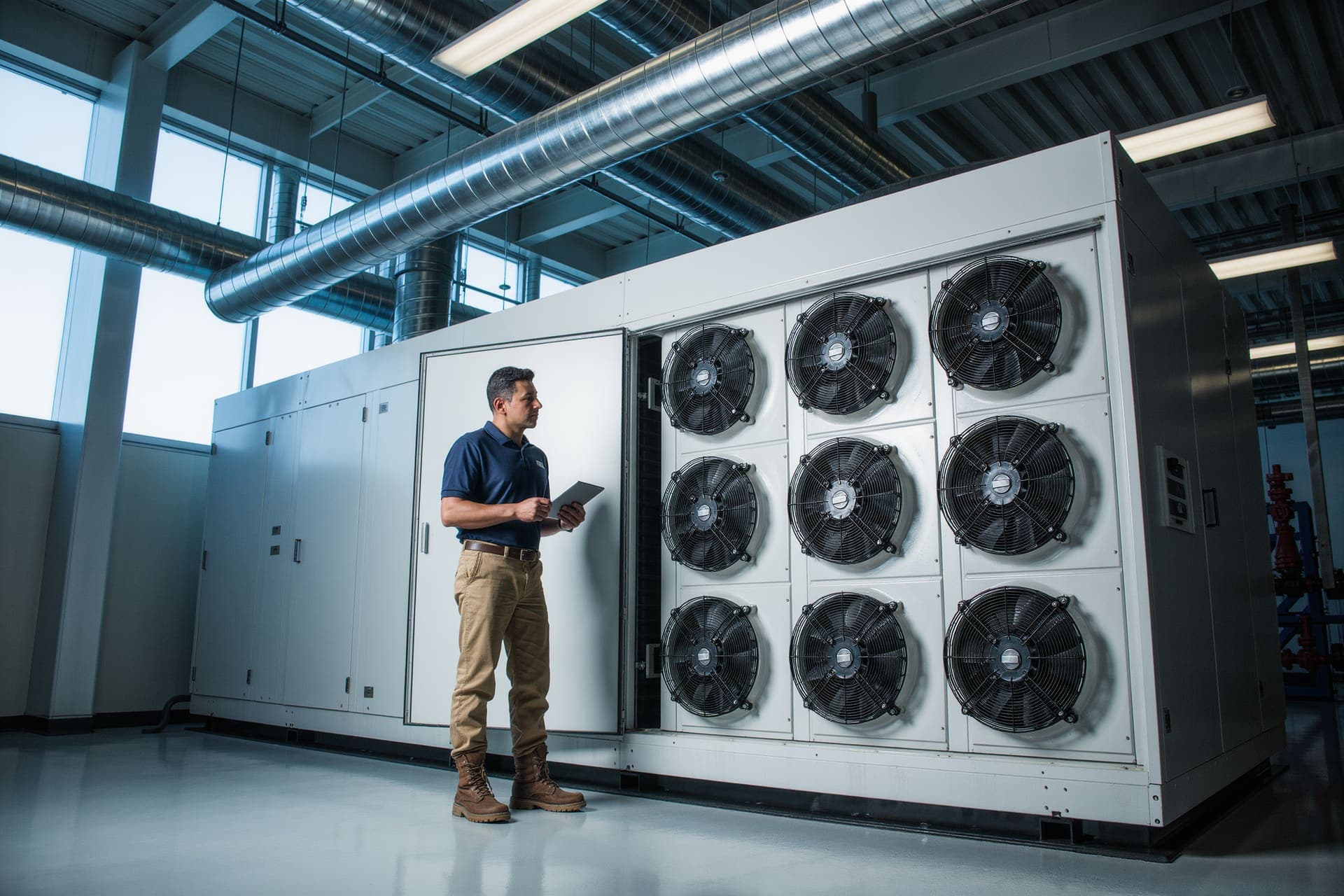
An air handler does the moving. It draws return air and outside air, filters it, passes it across cooling and heating coils, and pushes it into the ductwork with enough pressure to reach the far end of the building. In larger commercial properties — office towers, hospitals, laboratories, schools, data halls — the air handler is a modular or custom-built unit the size of a small room, fed by a chiller plant and supported by dozens of fan coils or terminal units downstream. Bleuwave services all of it: the AHU itself, its fans and motors, coils, filters, dampers, drives and controls, and the fan coils that hang off the loop.
In Phoenix the air handler carries an unusual burden. It is the machine that has to condition outside air pulled in at 115 degrees, and it is the machine that collects every particle of dust the building breathes. Filters load fast. Coils foul. Economizer dampers that are supposed to bring in free cooling on mild nights corrode in place. When an air handler underperforms, the symptom appears at the thermostat, but the cause is almost always upstream.
Symptoms We Are Called For
What It Looks Like, and What It Usually Is
| Symptom | Likely causes |
|---|---|
| Weak airflow at the far end of the building | Loaded filters, fouled coil, fan belt or bearing wear, a VFD running below setpoint, or a duct restriction. Static-pressure profiling locates it. |
| Supply air too warm on hot afternoons | Fouled cooling coil, chilled-water flow or temperature problem, economizer bringing in hot outside air, or a control valve failing to open. |
| Water below the unit | Blocked condensate drain, failed drain-pan float switch, coil sweating from airflow imbalance, or a casing seal that lets rain in on outdoor units. |
| Vibration or noise from the fan section | Fan wheel out of balance from dust loading, worn bearings, loose mounts, or a fan operating in an unstable region of its curve. |
| Rising energy cost with no change in occupancy | Economizer stuck open or closed, static-pressure setpoint too high, simultaneous heating and cooling from a controls fault, or fan efficiency loss. |
Air Handler Types in Commercial Buildings
The spectrum runs from light-commercial air handlers matched to a split-system condenser, through modular factory-built units from the major manufacturers, to fully custom air-handling systems engineered for a specific building. Custom and semi-custom units from Temtrol, ClimateCraft, Huntair, Haakon, Engineered Air and Mammoth are common in institutional and healthcare properties across the Valley, where airflow, filtration and outside-air requirements exceed what a catalog unit can deliver.
Inside any of them: a supply fan (increasingly a fan array rather than a single large wheel), a return or relief fan, filter banks, a chilled-water or DX cooling coil, a heating coil, mixing and economizer dampers, and the actuators and sensors that a building automation system uses to run it. Fan coils — from Enviro-Tec, Titus, Nailor, Price, Daikin, Williams and International Environmental — are the zone-level cousins: small units with a fan, filter and coil serving one room or one suite off a hydronic loop.
Why Phoenix Is Hard on Air Handlers
Outside-air load is the defining problem. Code requires a minimum quantity of fresh air per occupant, and in July that air arrives at a temperature that would make a coil designed for Ohio give up. Coils here run at higher capacity for more hours, and a coil that is even partially fouled with dust falls behind on the days it matters most.
Dust reaches every surface. It loads pre-filters in weeks during monsoon season, it coats coil fins, it accumulates on fan blades and throws them out of balance, and it settles in economizer dampers until the linkage seizes. An air handler that has gone two summers without a thorough cleaning is moving less air at higher static pressure than its design, and the building feels it as hot corners and rising utility bills.
Outdoor air handlers add UV, thermal cycling and monsoon rain to the list. Cabinet seals, insulation, damper seals and electrical enclosures all degrade faster than the equipment's nameplate suggests.
Assessment and Repair Scope
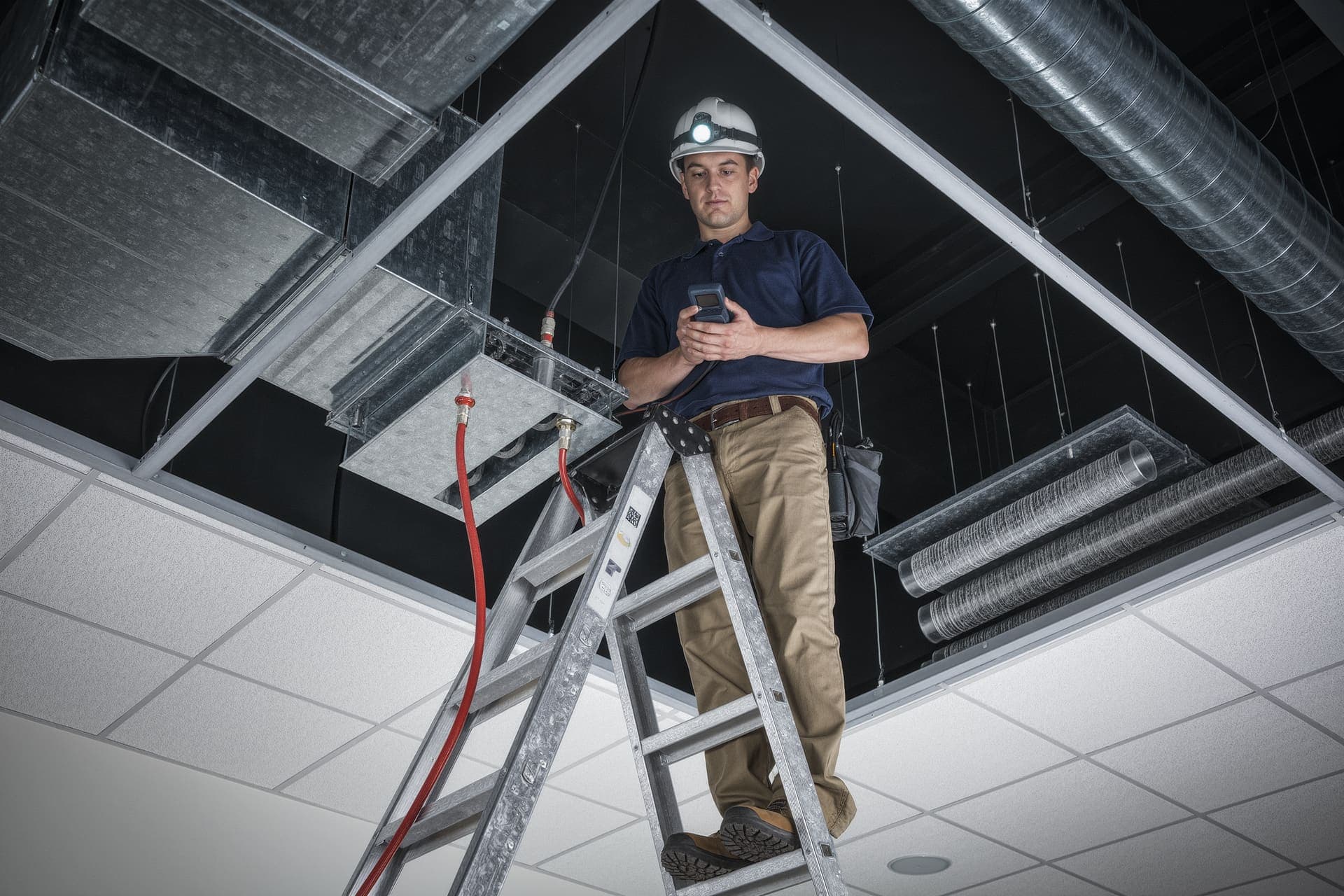
We measure what the air handler is actually doing against what it was designed to do: airflow, static pressure across each section, coil approach temperatures, motor amperage and VFD performance. Filter banks, coils and fan sections are inspected for fouling, corrosion and damage. Dampers and actuators are stroked and verified. Condensate drainage is checked, because a blocked pan in an air handler above a ceiling is a water-damage claim waiting to happen.
Repairs range from replacing a failed motor or bearing to coil replacement, fan-array retrofits, damper and actuator replacement, VFD replacement and control-point repair. A great deal of air-handler work is restorative rather than replacement: a twenty-year-old custom AHU with a sound casing can often be rebuilt — new coils, new fans, new controls — for a fraction of the cost and disruption of replacement, and that is a path we evaluate seriously before recommending a new unit.
Retrofit Versus Replacement
The casing is the asset. If it is structurally sound and the footprint still fits the building's needs, retrofitting internal components produces a like-new air handler without the rigging, roof work, duct transitions and downtime of a full replacement. Fan-array conversions are a common example: replacing a single large plenum fan with an array of smaller direct-drive fans improves efficiency, redundancy and serviceability without touching the casing.
Replacement becomes the better answer when the unit is undersized for current occupancy or outside-air requirements, when corrosion has compromised the structure, when the coil circuiting cannot be matched to a modern chiller plant, or when the cost of sequential component repairs is approaching the cost of a new unit. Our assessment shows the comparison in writing.
Controls Integration
A modern air handler is only as good as its sequence of operations. Supply-air temperature reset, static-pressure reset, economizer logic, demand-controlled ventilation and fan speed all live in the building automation system. Many air handlers we assess are mechanically sound but poorly sequenced — running full static pressure at all hours, economizing at the wrong times, or ignoring outside-air conditions entirely. Correcting the sequence is frequently the highest-return work on the whole system, and we coordinate it with the building automation practice.
Manufacturers We Encounter
Brands in the Air Handlers Category
Bleuwave services these manufacturers on an independent basis. Each page covers the families we see in Phoenix and how we approach them.
Straight Answers
Questions We Hear on This One
Can an old custom air handler be rebuilt instead of replaced?
Often, yes. If the casing is sound, replacing coils, fans, dampers, filters and controls can deliver near-new performance for a fraction of replacement cost and without the crane. We evaluate the casing condition first, then price a rebuild against a replacement.
What is a fan-array retrofit?
Replacing a single large supply fan with an array of smaller direct-drive fans. It improves efficiency, provides redundancy if one fan fails, simplifies maintenance and typically reduces noise. It is one of the most common upgrades we perform on institutional air handlers.
How often should commercial air handler filters be changed in Phoenix?
More often than the manufacturer's national guidance suggests. Pre-filters in dusty locations can load in four to six weeks during monsoon season. We set filter schedules by measured pressure drop, not the calendar.
Do you service fan coil units?
Yes — hydronic and DX fan coils from the major terminal-equipment manufacturers, including coil cleaning, valve and actuator replacement, motor replacement and controls repair.
Free Commercial Estimate
Get a Straight Answer and a Free Estimate
Tell us what the building needs. We'll tell you what it costs — plainly, promptly, and without a sales pitch.
Same-day response. Answered by a person with the authority to act, not a queue with a hold song.
Upfront pricing. The figure quoted is the figure invoiced. The arithmetic never changes after the fact.
Veteran owned & operated. Early, exact, and accountable — the doctrine came before the company.
Prefer the phone? It's answered around the clock: (480) 863-5855