Commercial HVAC Equipment
Commercial Split System Repair & Replacement in Phoenix, AZ
Two boxes, one system. When half of it fails, the other half decides what happens next.
A commercial split system puts the condensing unit outside — on a roof, a pad or a mechanical yard — and the air handler inside, joined by refrigerant lines that may run fifty feet or more. It is the standard arrangement for tenant suites, small offices, schools, worship facilities and any building where a packaged rooftop unit does not fit the ductwork or the roof. Bleuwave evaluates commercial split systems as a matched pair: the outdoor unit, the indoor air handler or coil, the line set between them, the electrical service and the controls. When one side is failing, we tell you what that means for the other.
Phoenix is not kind to the outdoor half. A condensing unit on a west-facing pad or an open roof spends every afternoon from May through September rejecting heat into air that is already 110 degrees. Compressors run long. Fan motors run hot. Contactors pit. Refrigerant charge drifts as small leaks open under thermal stress. The indoor half, meanwhile, collects the dust that finds its way through every return grille in the Valley. Most of what goes wrong with a commercial split system in this market can be traced to heat, dust or the combination.
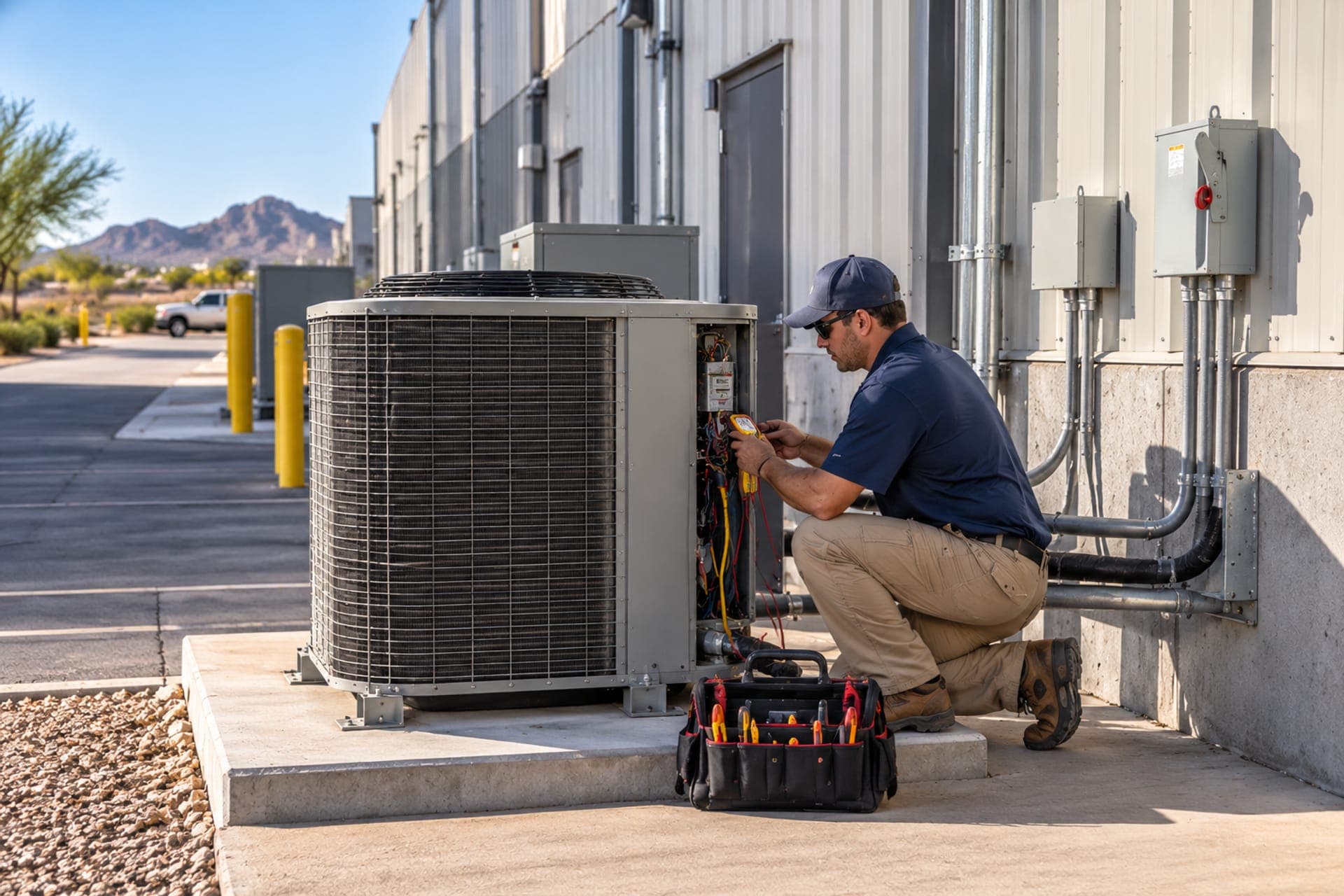
Symptoms We Are Called For
What It Looks Like, and What It Usually Is
| Symptom | Likely causes |
|---|---|
| Outdoor unit runs but supply air is warm | Low refrigerant charge, failed compressor valves, a stuck or failed metering device, or an indoor blower not moving air. Requires pressure and airflow testing on site. |
| Ice on the indoor coil or line set | Restricted airflow from a loaded filter or dirty coil, low charge, or a failed blower motor. The ice is the symptom; the airflow or charge is the cause. |
| Breaker trips in the afternoon | A compressor drawing locked-rotor amps, a failing run capacitor, a shorted fan motor, or high head pressure from a dirty condenser coil. Heat makes each of these worse. |
| Short cycling | Oversized equipment, a failing contactor or control board, a refrigerant-pressure safety tripping, or a thermostat placed where it reads the wrong temperature. |
| Outdoor unit will not start | Failed capacitor, pitted contactor, tripped high-pressure switch, blown low-voltage fuse, or a control signal that never arrives. |
How Commercial Split Systems Are Applied
Commercial splits range from three-ton units serving a single tenant suite to twenty-ton systems paired with substantial indoor air handlers. Configurations include cooling-only condensers matched to gas-heat air handlers, heat pumps for buildings without gas service, and multi-circuit systems where one outdoor unit carries two refrigeration circuits for staging. Indoor sections run horizontal in ceiling plenums, vertical in closets, or as coils dropped into existing furnaces and air handlers.
The equipment families a facility manager is likely to find on a nameplate include Trane Odyssey and the older TTA/TWA lines, Carrier Gemini with its 38AU and 40RU pairings, Lennox Elite and the TSA/TPA commercial series, YORK Predator and Sunline splits, Daikin SkyAir, and the Rheem/Ruud Commercial Classic families. Older buildings still carry R-22 splits from every one of those manufacturers, which changes the repair-versus-replace math considerably.
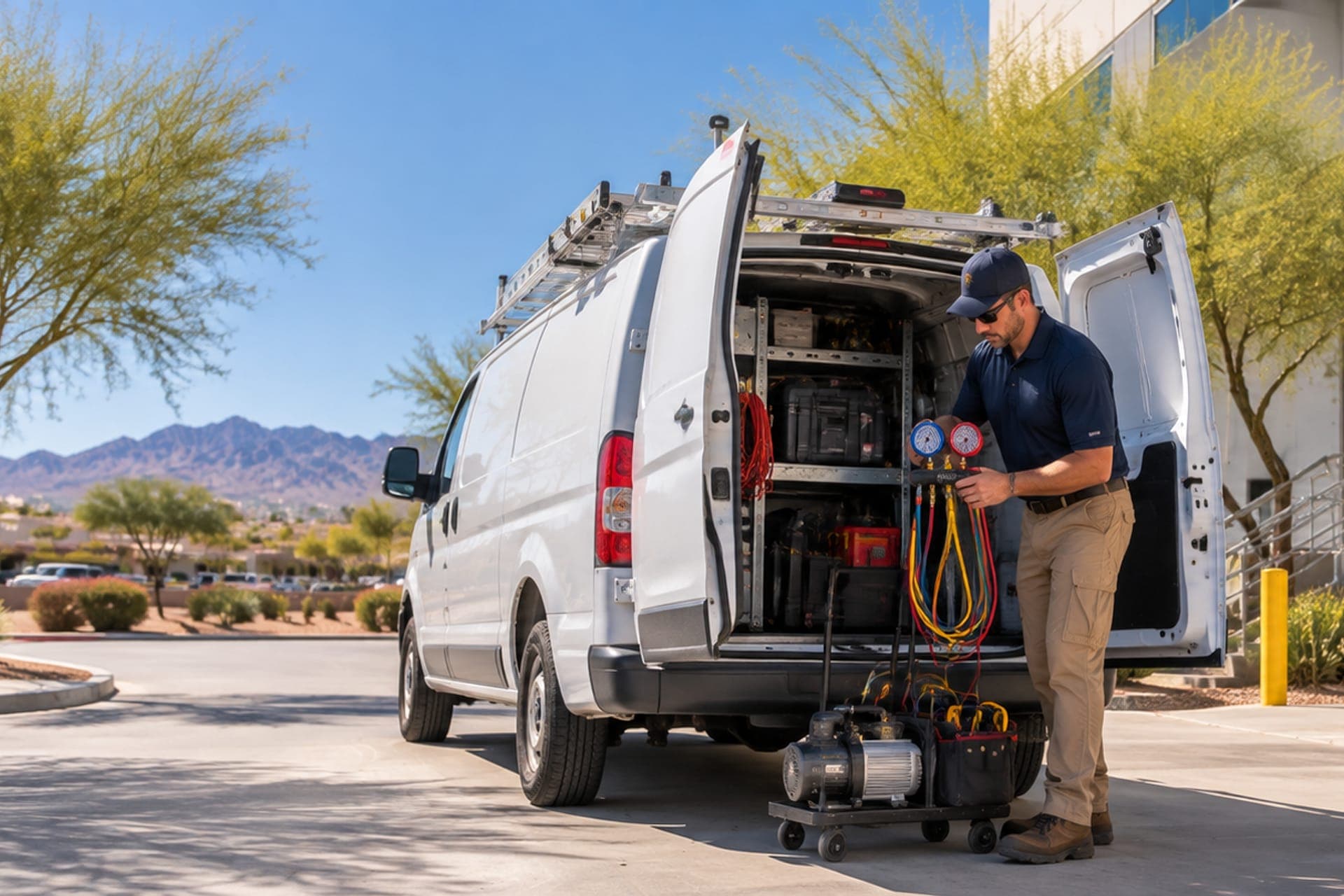
What Phoenix Does to a Split System
The outdoor unit is the exposed one. Its condenser coil rejects the building's heat to the ambient air, and when ambient is 112 degrees, the coil has to run hotter still to move heat across the difference. That raises head pressure, which raises compressor amperage, which raises the temperature of everything in the electrical compartment. A capacitor rated for a mild climate does not last here. Neither does a contactor with slightly pitted contacts.
Dust is the second enemy. Monsoon season loads condenser fins with a fine coating that blocks airflow and compounds the heat problem. On the indoor side, the same dust reaches the evaporator coil and the blower wheel, reducing airflow until the coil runs cold enough to freeze — which looks, at first, like a refrigerant problem and is usually a maintenance one.
Long line sets add a third factor. A fifty-foot refrigerant run across a hot roof is a heat exchanger in its own right, and it gives small leaks time to matter. A system that was correctly charged in April can be measurably low by August without a single dramatic failure.
Diagnostic Approach
We start where the money is: the compressor. Amperage against nameplate, winding resistance, and a check for the acid and moisture that signal a system on its way to a burnout. Then refrigerant pressures and temperatures — superheat and subcooling against the manufacturer's targets, which tells us whether the charge is right and whether the metering device is doing its job. Airflow at the indoor unit is measured, not assumed, because a coil that is starved for air produces the same symptoms as a coil that is low on charge, and the fixes cost very different amounts.
Electrical inspection covers the contactor, capacitors, fan motors, crankcase heater and every connection that spends the summer on a hot roof. Controls are traced from the thermostat or building automation output through to the equipment, since a surprising share of "the unit doesn't run" calls end at a failed low-voltage transformer or a control board that took a monsoon surge.
Repair or Replace: The Matched-System Question
Split systems fail in halves, which creates a decision that packaged units do not. When a fifteen-year-old condensing unit dies, the tempting move is to replace only the outdoor section. Sometimes that is right. Often it is not: modern condensers are designed around specific indoor coils and expansion devices, and a new outdoor unit married to an old air handler can underperform its rating, short-cycle, or fail early. If the old system runs R-22, a like-for-like outdoor replacement is no longer available, and a refrigerant conversion of the existing indoor coil is its own project.
Our assessment lays out the options honestly: repair the failed component, replace the outdoor unit with a compatible match, or replace the system as a pair. Each comes with a number, an expected service life, and an efficiency estimate against your current utility spend. Nothing is recommended without the arithmetic to support it.
Replacement Process
Replacing a commercial split system is more than swapping boxes. We survey the existing line set — whether it can be reused, flushed or must be replaced for a new refrigerant — the electrical service, the condensate drainage, the indoor unit's location and access, and the controls integration. Roof-mounted condensers may need rigging; ground-mounted units may need a new pad. Permits are pulled, the system is evacuated and charged to specification, and airflow is balanced at the registers before startup. You receive commissioning data, registered warranties and a maintenance recommendation calibrated to how hard the system will actually work.
Manufacturers We Encounter
Brands in the Split Systems Category
Bleuwave services these manufacturers on an independent basis. Each page covers the families we see in Phoenix and how we approach them.
Straight Answers
Questions We Hear on This One
Can you replace just the outdoor unit on our commercial split system?
Sometimes. If the indoor coil is compatible with the new condenser's refrigerant and expansion device, and it is in good condition, a matched outdoor replacement can be a sound decision. If the system runs R-22, or the indoor unit is near the end of its own life, replacing the pair usually costs less over the next ten years. We show you both numbers.
Our split system is R-22. What are our options?
R-22 is no longer produced, and the remaining reclaimed supply is expensive. A small leak repair may still be worth doing on a system with years of life left. A major refrigerant loss on an older system generally tips the decision toward replacement with current equipment. We price both paths.
How long should a commercial split system last in Phoenix?
The outdoor unit takes the punishment. Well maintained, twelve to fifteen years is typical here; neglected, closer to ten. Indoor air handlers often outlast the condenser by several years, which is part of why the matched-system question comes up so often.
Do you service the older Trane, Carrier and YORK split lines?
Yes. Legacy commercial splits from the major manufacturers remain common in Phoenix tenant buildings, and we service them on an independent basis. Parts availability varies by age and family, and we tell you when a part has become scarce enough to affect the repair decision.
Free Commercial Estimate
Get a Straight Answer and a Free Estimate
Tell us what the building needs. We'll tell you what it costs — plainly, promptly, and without a sales pitch.
Same-day response. Answered by a person with the authority to act, not a queue with a hold song.
Upfront pricing. The figure quoted is the figure invoiced. The arithmetic never changes after the fact.
Veteran owned & operated. Early, exact, and accountable — the doctrine came before the company.
Prefer the phone? It's answered around the clock: (480) 863-5855