Commercial HVAC Equipment
DOAS, Make-Up Air & Energy Recovery Service in Phoenix, AZ
Every building has to breathe outside air. In July, outside air is the most expensive thing you can bring indoors.
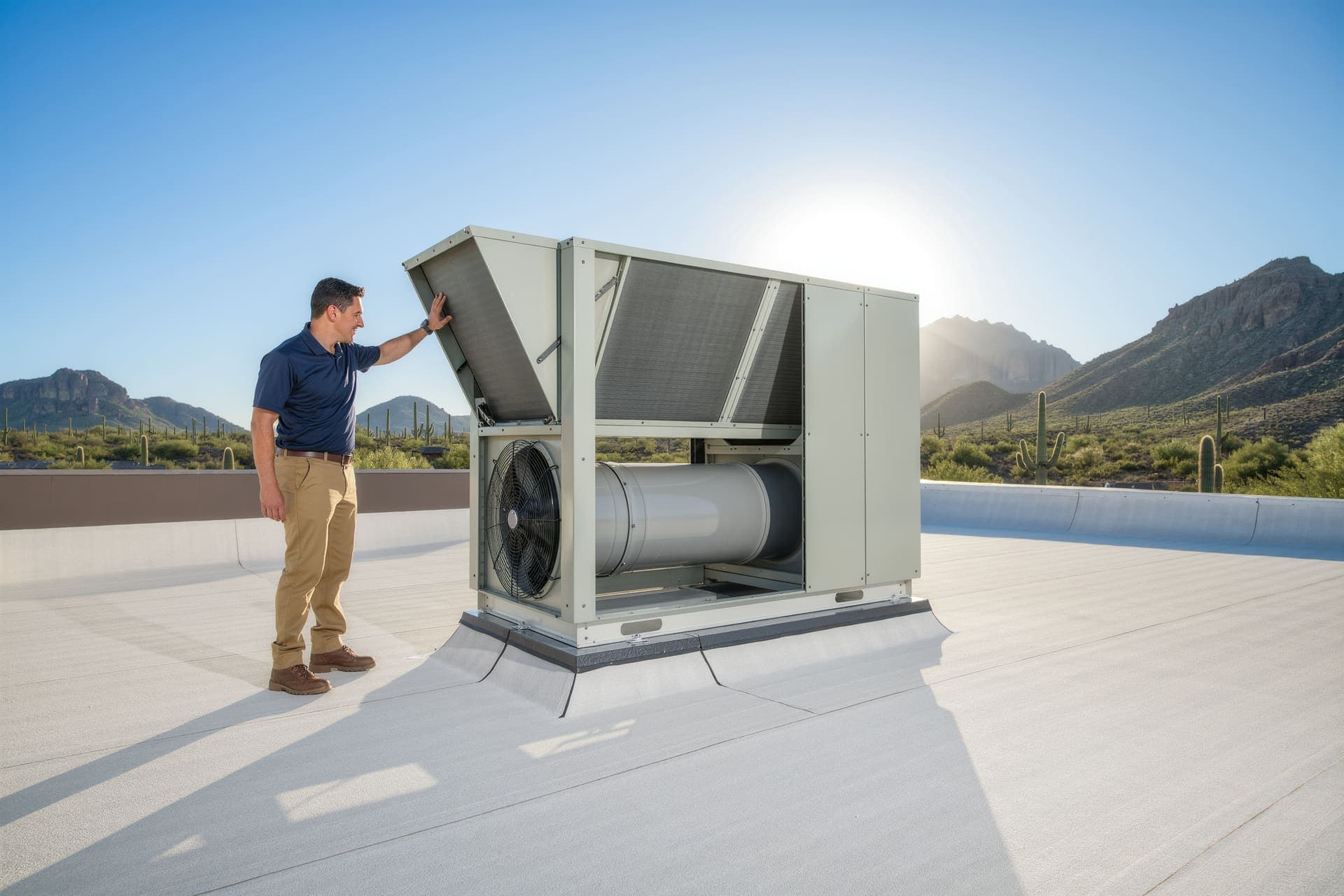
Codes require commercial buildings to bring in a minimum quantity of outside air for the people inside. Kitchens require make-up air to replace what the hoods exhaust. Both requirements collide with Phoenix reality: outside air in summer arrives at 110 to 118 degrees, and every cubic foot of it has to be cooled before it can be delivered. Dedicated outdoor-air systems, make-up air units and energy-recovery ventilators exist to handle that load efficiently and separately from the equipment that conditions the space. Bleuwave services all of them.
When this equipment fails, the building does not always notice immediately. Rooms grow stuffy. Carbon dioxide climbs and afternoon meetings drag. Kitchen doors whistle and pilot lights blow out as the hoods pull the building into negative pressure. The rooftop units, starved of properly tempered outside air, fall behind on hot days for reasons nobody can identify from the thermostat. Ventilation problems masquerade as comfort problems, and diagnosing them requires knowing where to look.
Symptoms We Are Called For
What It Looks Like, and What It Usually Is
| Symptom | Likely causes |
|---|---|
| Stuffy rooms and afternoon fatigue complaints | Insufficient outside air — a stuck damper, failed DOAS unit, fouled ERV, or ventilation controls disabled to save energy. |
| Exterior doors hard to open; drafts at the entrance | Negative building pressure from exhaust exceeding make-up air. Common in restaurants when the MAU has failed or is undersized. |
| Rooftop units cannot keep up on hot days | Untempered outside air overwhelming the cooling capacity — a DOAS or ERV that is not doing its job. |
| Pilot lights blowing out; water heater flue odors | Backdrafting from negative pressure — a make-up air failure with a safety dimension. |
| High energy use out of proportion to occupancy | Ventilation running at full rate regardless of occupancy, energy-recovery wheel stopped, or outside-air damper stuck open. |
The Equipment
A dedicated outdoor-air system conditions 100 percent outside air — cooling, dehumidifying, sometimes heating it — and delivers it to the building separately from recirculated air. Greenheck, CaptiveAire Paragon, Addison, AAON RN and RZ, Daikin Applied Rebel Applied, SEMCO Pinnacle and Munters DryCool are common DOAS and outside-air families. Energy-recovery ventilators from RenewAire, Greenheck, SEMCO and others pass exhaust air and incoming air across a wheel or plate exchanger so that outgoing conditioned air pre-cools the incoming hot air — a technology with an unusually strong payback in this climate.
Make-up air units serve kitchens and industrial spaces: CaptiveAire and Greenheck kitchen MAUs paired with hood exhaust, Reznor YDMA and MAPS, Modine Atherion, Engineered Air DJ, and Cambridge Air Solutions direct-fired units for warehouses. Desert Aire and Munters supply dehumidification-focused systems for pools and indoor agriculture, where latent load rather than sensible heat is the challenge.

Outside Air in the Desert
The arithmetic is brutal. Cooling outside air from 115 degrees to a 55-degree supply temperature takes roughly three times the energy of cooling recirculated air from 78. A building that meets its ventilation requirement with untreated outside air dumped into the return duct is spending a large and invisible share of its cooling bill on the code minimum. A DOAS with energy recovery reclaims a substantial portion of that, which is why the equipment pays for itself faster here than nearly anywhere.
Dust is the operational problem. Outside-air intakes are, by definition, the dirtiest point in the system. Filters on DOAS and MAU equipment load quickly in monsoon season, energy-recovery wheels foul, and dampers seize. A ventilation unit that has not been serviced through a Phoenix summer is likely moving a fraction of its design airflow.
Kitchen Make-Up Air and Pressurization
A restaurant hood can exhaust several thousand cubic feet of air per minute. If make-up air does not replace it, the building goes negative: doors are hard to open, outdoor air infiltrates through every gap, pilot lights and water-heater flues backdraft, and the dining room's air conditioning loses a fight it never signed up for. Kitchen MAUs are engineered to balance the exhaust, often with tempering — cooling or heating the incoming air — and interlocks with the hood controls. We service them as part of commercial kitchen ventilation and as standalone equipment.
Assessment, Repair and Replacement
We measure outside-air quantity against the code and design requirement, check building pressurization, inspect filters, coils, energy-recovery media, dampers, actuators and fans, and verify controls sequences — especially demand-controlled ventilation, where carbon-dioxide sensors modulate outside air to occupancy. Repairs cover the full range from filter and wheel cleaning to coil, fan, burner, damper and control replacement.
Replacement is warranted when a unit can no longer meet the building's ventilation requirement, when its efficiency is poor enough that an energy-recovery upgrade pays quickly, or when a change of use — a new restaurant tenant, a converted office — changes the outside-air requirement entirely. Sizing is done from occupancy, exhaust and code, not from the old nameplate.
Manufacturers We Encounter
Brands in the DOAS & Make-Up Air Category
Bleuwave services these manufacturers on an independent basis. Each page covers the families we see in Phoenix and how we approach them.
Straight Answers
Questions We Hear on This One
What is a DOAS and why would our building need one?
A dedicated outdoor-air system conditions the code-required outside air separately from the equipment that cools the space. In Phoenix, where outside air is the most expensive air to condition, a DOAS with energy recovery reclaims much of that cost and lets the main equipment be sized for the space load alone.
Does energy recovery make sense in a dry climate?
Yes — arguably more than in humid ones for sensible heat. An energy-recovery wheel or plate uses the building's cool exhaust air to pre-cool 115-degree incoming air. The larger the temperature difference, the more it recovers, and Phoenix summers provide a very large difference.
Our restaurant kitchen is unbearably hot even with the hood running. Why?
Usually inadequate make-up air. The hood is pulling conditioned air out of the building faster than it is replaced, so the kitchen runs hot and negative. A make-up air assessment finds the imbalance and the fix.
How often should DOAS and make-up air filters be changed here?
By measured pressure drop rather than the calendar, and expect it to be frequent — outside-air intakes are the dirtiest point in the system, and monsoon season can load a filter in weeks.
Free Commercial Estimate
Get a Straight Answer and a Free Estimate
Tell us what the building needs. We'll tell you what it costs — plainly, promptly, and without a sales pitch.
Same-day response. Answered by a person with the authority to act, not a queue with a hold song.
Upfront pricing. The figure quoted is the figure invoiced. The arithmetic never changes after the fact.
Veteran owned & operated. Early, exact, and accountable — the doctrine came before the company.
Prefer the phone? It's answered around the clock: (480) 863-5855