Commercial HVAC Equipment
Water-Source Heat Pump Repair & Replacement in Phoenix, AZ
Fifty small machines sharing one loop of water. When the loop is unhappy, all fifty tell you at once.
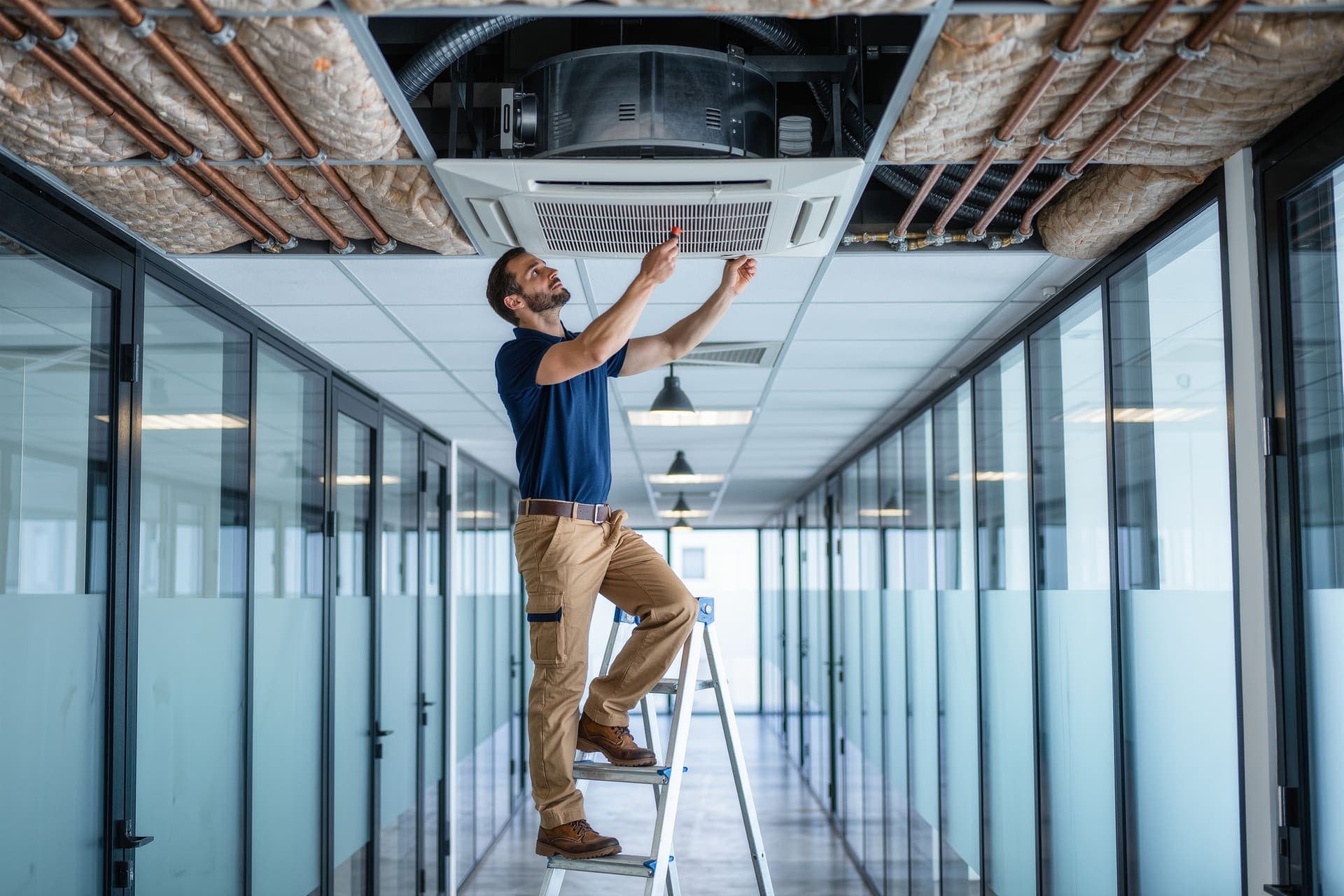
A water-source heat pump system distributes cooling and heating across a building through many small heat pumps — one per office, suite or zone — all connected to a common water loop. Each unit rejects heat to the loop when cooling and draws heat from it when heating. A cooling tower keeps the loop from getting too warm; a boiler keeps it from getting too cold. It is a popular arrangement in Phoenix office buildings, hotels, schools and multifamily properties because it zones well, meters easily and puts no refrigerant piping in the ceiling. Bleuwave services the whole system: the zone units, the loop pumps, the tower, the boiler and the water itself.
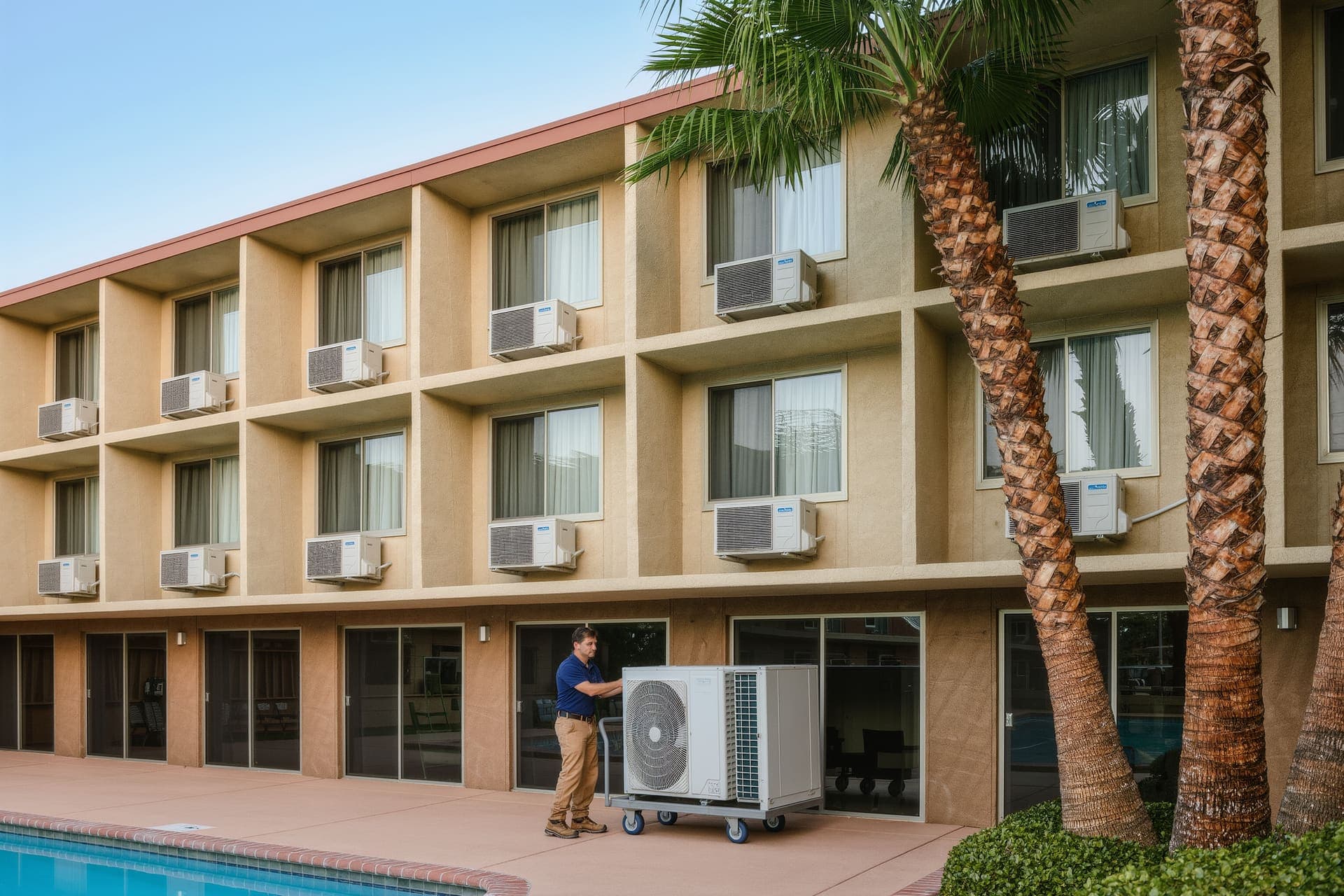
The design has one vulnerability that Phoenix exposes without mercy: everything depends on the loop staying within its temperature range. In a Valley summer, nearly every unit in the building is rejecting heat into the loop at once, and the cooling tower has to shed all of it into 110-degree air. When the tower falls behind, loop temperature climbs, head pressures climb with it, and heat pumps start locking out on high-pressure safeties. The complaint calls come from every floor.
Symptoms We Are Called For
What It Looks Like, and What It Usually Is
| Symptom | Likely causes |
|---|---|
| Multiple units lock out on hot afternoons | Loop temperature above range — tower underperforming, low loop flow, or lapsed water treatment. A loop-side problem, not a unit problem. |
| One unit trips repeatedly while neighbors run | Scaled heat exchanger on that unit, failed water valve or strainer, low refrigerant, or a compressor nearing failure. |
| Unit runs but neither heats nor cools well | Reversing valve failure, low charge, fouled air coil, or restricted water flow through the unit. |
| Rising pressure drop across units building-wide | Scale accumulation from inadequate water treatment. A chemistry problem that becomes a mechanical one. |
| Loop pumps cavitating or noisy | Air in the loop, low system pressure, a failed expansion tank, or a clogged strainer. |
The Equipment You Will Find
Zone units come in horizontal configurations for ceiling plenums, vertical units for closets, console units along exterior walls and rooftop units for larger zones. ClimateMaster Tranquility and Genesis, the Bosch and legacy FHP (Florida Heat Pump) LM, LV, EC and MC families, WaterFurnace Versatec and Envision, Trane Axiom, Carrier AquaZone, Daikin and legacy McQuay Enfinity, and the Johnson Controls/YORK Affinity lines are all common on Phoenix nameplates. Buildings from the 1980s and 1990s frequently carry FHP-labeled units that predate the Bosch acquisition — they remain serviceable, and their name is often exactly what a facility manager types into a search.
Supporting the units: loop circulation pumps (often with VFDs), a cooling tower or closed-circuit fluid cooler, a boiler or electric heater for winter loop temperature, expansion tanks, strainers, and the water-treatment system that keeps all of it from scaling or corroding.
Phoenix and the Loop
Loop temperature is the health metric. Design typically calls for the loop to stay between roughly 60 and 90 degrees. In August, with every unit in cooling and the tower working against extreme ambient temperatures and low wet-bulb margins, the loop can drift above 95, and at that point heat pumps begin tripping on high head pressure. A tower with degraded fill, a scaled heat exchanger, a failed fan or a fouled basin cannot keep up, and the entire building suffers for one piece of equipment on the roof.
Water quality compounds it. Phoenix municipal water is hard, and a loop that is not treated and monitored scales the heat exchangers inside every zone unit. Scale insulates; insulated heat exchangers cannot reject heat; units lock out. Water treatment is not a housekeeping item on a water-source system here. It is mechanical maintenance.
Diagnostics: Unit or Loop?
The first question on any water-source call is whether the problem belongs to one unit or to the loop. A single unit locking out while its neighbors run is a unit problem: a failed compressor, a fouled heat exchanger, a stuck reversing valve, a bad water valve or a control fault. Multiple units locking out across the building points to the loop — temperature out of range, flow too low, or water treatment that has lapsed. We check loop supply and return temperatures, flow, and tower and boiler performance before condemning any individual machine.
Individual unit diagnostics cover refrigerant pressures, waterside pressure drop across the coaxial heat exchanger (a rising drop signals scale), compressor amperage, reversing valve operation, condensate drainage and the unit controller.
Phased Replacement
The great advantage of a water-source system is that it can be replaced one unit at a time. There is no single day when the building loses cooling. Units are typically replaced in order of age and reliability, often floor by floor or as tenant spaces turn over, and modern units drop into the same loop connections with improved efficiency and quieter operation. We build multi-year replacement schedules from maintenance data so capital planning replaces emergency purchasing.
Loop-side replacements — the cooling tower, pumps, boiler and water treatment — are scheduled separately and often deserve priority, because a new fleet of zone units on a failing tower is still a failing system.
Controls
Water-source systems benefit enormously from building automation: loop temperature reset, tower fan staging, pump speed control, unit scheduling and fault reporting. A system where fifty units each report a lockout to a central dashboard gets fixed in an hour; one where fifty tenants call the property manager takes a week. We integrate zone units and loop equipment with the site's building automation or install supervisory controls where none exist.
Manufacturers We Encounter
Brands in the Water-Source Heat Pumps Category
Bleuwave services these manufacturers on an independent basis. Each page covers the families we see in Phoenix and how we approach them.
Straight Answers
Questions We Hear on This One
Our building has FHP units. Can you still service them?
Yes. FHP — Florida Heat Pump — units remain common in Phoenix buildings from the 1980s through the 2000s. The brand now sits within Bosch, and we service the legacy units on an independent basis. Parts availability varies by age; we advise when a component has become scarce enough to influence the repair decision.
Why do all our heat pumps fail on the same afternoon?
Almost certainly the loop, not the units. When loop temperature climbs past its design range, every unit in cooling hits its high-pressure safety at roughly the same time. The fix is on the roof — tower, pumps or water treatment — not in fifty ceiling units.
Can we replace water-source heat pumps one at a time?
That is the strength of the design. Units are replaced individually, typically by age and reliability, with no building-wide shutdown. We build the schedule from maintenance data so it fits your capital plan.
How important is water treatment on a water-source loop in Phoenix?
Essential. Phoenix water is hard, and untreated loops scale the heat exchangers in every unit on the system. Treatment and monitoring are mechanical maintenance here, not an optional service.
Free Commercial Estimate
Get a Straight Answer and a Free Estimate
Tell us what the building needs. We'll tell you what it costs — plainly, promptly, and without a sales pitch.
Same-day response. Answered by a person with the authority to act, not a queue with a hold song.
Upfront pricing. The figure quoted is the figure invoiced. The arithmetic never changes after the fact.
Veteran owned & operated. Early, exact, and accountable — the doctrine came before the company.
Prefer the phone? It's answered around the clock: (480) 863-5855