Commercial HVAC Equipment
Cooling Tower Repair, Service & Replacement in Phoenix, AZ
Everything the chiller plant cannot get rid of ends up here. In August, that is a great deal of heat.
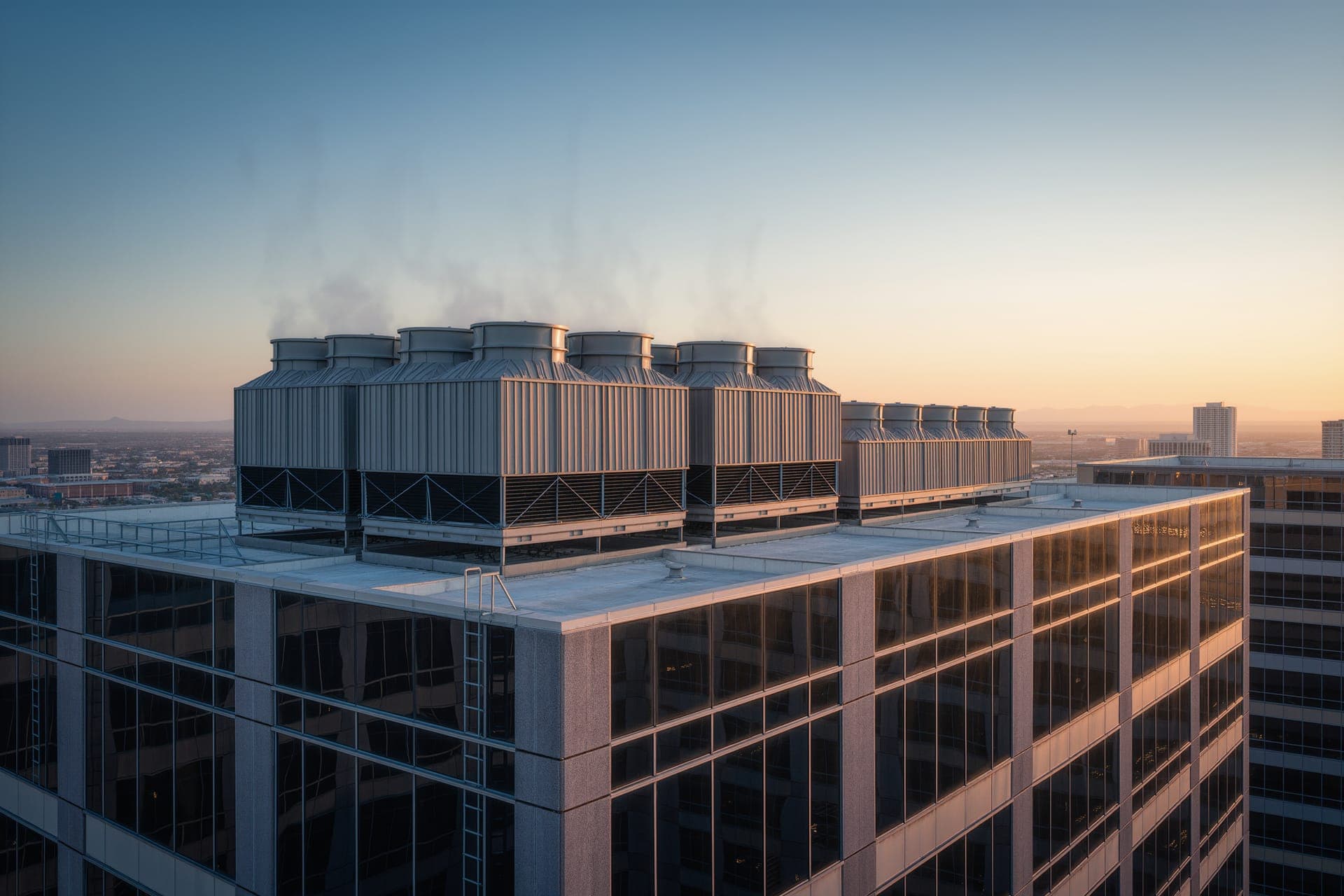
A cooling tower is the last stop for every BTU a water-cooled chiller or water-source loop removes from a building. It rejects that heat to the atmosphere by evaporating a fraction of the water passing through it, which is an elegant idea in a dry climate and a demanding one when the dry climate reaches 115 degrees. Bleuwave services open-circuit cooling towers, closed-circuit fluid coolers and evaporative condensers: fill, drift eliminators, distribution systems, fans and drives, gearboxes, basins, float valves, sump pumps and the water treatment that decides how long all of it lasts.
Phoenix is, in one respect, the ideal cooling-tower climate. Low humidity means a low wet-bulb temperature, and a tower can chill water well below what the dry-bulb thermometer suggests. The trade is evaporation rate: a tower here consumes water at a pace that surprises operators from wetter markets, concentrates minerals fast in a city with hard water, and runs its fans and fill at full duty for six months without relief.
Symptoms We Are Called For
What It Looks Like, and What It Usually Is
| Symptom | Likely causes |
|---|---|
| Chiller running at high condensing pressure | Tower approach has widened — scaled or fouled fill, failed fan, restricted distribution, or low airflow. The chiller is the messenger; the tower is the message. |
| Rapidly rising water use | Excessive bleed-off, a failed float or make-up valve, drift from damaged eliminators, or a basin leak. |
| White deposits on fill and casing | Scale from concentrated minerals — water treatment has lapsed or is under-dosed for Phoenix water hardness. |
| Fan noise or vibration | Blade imbalance, worn gearbox, misaligned drive shaft, or loose fan hub. |
| Algae or biological growth in the basin | Biocide program inadequate, sunlight on the basin, or debris accumulation feeding growth. A water-management issue with health implications. |
Tower Types and Manufacturers
Factory-assembled crossflow and counterflow towers from Baltimore Aircoil Company (Series 3000, FXV, CXV and VXT), EVAPCO (AT, LSTE, ESWA and the closed-circuit families) and SPX Cooling Technologies' Marley line (NC, MD, AV and Aquatower) make up most of the installed base on Phoenix commercial roofs and mechanical yards. Delta Cooling Towers builds corrosion-resistant HDPE towers, and Tower Tech supplies modular counterflow designs. Older properties may still operate field-erected wood, steel or fiberglass towers whose structures deserve as much inspection as their mechanical components.
Closed-circuit fluid coolers keep the process fluid inside a coil and spray water over the outside, which protects water-source loops and process systems from contamination at the cost of some efficiency. Evaporative condensers do the same job for refrigeration systems, condensing refrigerant directly in the coil.
What the Desert Does to a Tower
Scale is the chronic problem. As water evaporates, dissolved minerals stay behind and concentrate. Without bleed-off and chemical treatment calibrated to Phoenix water, scale coats the fill, narrows the distribution nozzles and insulates the heat-transfer surfaces. A scaled tower runs warmer, the chiller it serves runs at higher condensing pressure, and the electric bill absorbs the difference every hour.
Dust and monsoon debris load the basin and the fill. Sunlight degrades PVC fill and fiberglass casings over years of exposure. Fan motors, gearboxes and drive shafts run continuously through the season with no cool nights to recover. And because a tower is an open water system, it is also a biological one: Legionella management and basin cleanliness are part of responsible operation, not an afterthought.
Inspection and Repair Scope
A thorough tower inspection covers fill condition and fouling, drift eliminator integrity, distribution basin and nozzle condition, cold-water basin sediment, structural condition of the casing and supports, fan blade pitch and balance, motor and gearbox condition, drive alignment, float and make-up valve operation, and water chemistry. We measure approach — the difference between leaving-water temperature and wet-bulb — because approach is the single number that says whether a tower is doing its job.
Repairs range from fill and eliminator replacement, nozzle cleaning, basin repair and coating, fan and motor replacement, gearbox rebuilds or replacement, and structural reinforcement, through to complete tower replacement. Tower fill replacement in particular is an underused intervention: new fill in a sound casing frequently restores full design capacity to a tower that had been quietly starving its chiller for years.
Replacement Considerations
Tower replacement is a rigging project first. The old tower comes off by crane, the new one goes on, and the window between them is the building's cooling outage — so it is scheduled for the mildest available weather and the lowest occupancy. Structural steel, piping connections, electrical service, VFD integration, water-treatment tie-ins and controls are surveyed in advance. Right-sizing is revisited, since the original tower may have been selected for a chiller plant that has since changed.
Modern towers offer variable-speed fans, better drift eliminators, corrosion-resistant construction and sound attenuation options. For a Phoenix property, a tower selected with local wet-bulb data and a realistic water-treatment plan is a meaningfully different machine from one chosen from a national catalog.
Manufacturers We Encounter
Brands in the Cooling Towers Category
Bleuwave services these manufacturers on an independent basis. Each page covers the families we see in Phoenix and how we approach them.
Straight Answers
Questions We Hear on This One
How much water does a cooling tower use in Phoenix?
More than in nearly any other market. Low humidity drives high evaporation, and bleed-off adds to it. A properly tuned water-treatment program minimizes bleed-off while controlling scale; a poorly tuned one wastes water and still scales the tower.
Can tower fill be replaced instead of replacing the whole tower?
Frequently, and it is one of the best-value repairs available. New fill in a structurally sound casing can restore design capacity and bring the chiller's condensing pressure back down. We assess casing and structure before recommending it.
Do you handle Legionella and water management?
We coordinate tower cleaning, basin maintenance and water-treatment programs, and we work with your water-treatment provider on chemistry and biocide protocols. Open cooling towers require a documented water-management program; we help keep yours current.
When is the best time to replace a cooling tower?
The cooler months, when the cooling outage during the swap costs the least. Planning a spring or fall replacement is far better than an emergency replacement in July, which is why we forecast tower condition on maintenance plans.
Related Services
Related Equipment
Free Commercial Estimate
Get a Straight Answer and a Free Estimate
Tell us what the building needs. We'll tell you what it costs — plainly, promptly, and without a sales pitch.
Same-day response. Answered by a person with the authority to act, not a queue with a hold song.
Upfront pricing. The figure quoted is the figure invoiced. The arithmetic never changes after the fact.
Veteran owned & operated. Early, exact, and accountable — the doctrine came before the company.
Prefer the phone? It's answered around the clock: (480) 863-5855