Commercial HVAC Equipment
Commercial Evaporative Cooling Repair & Service in Phoenix, AZ
The oldest cooling technology in Arizona, and in the right building, still the cheapest.
Evaporative cooling is the technology that made Phoenix habitable before refrigeration was affordable, and it remains the most economical way to cool large open spaces in a dry climate. A direct evaporative cooler passes hot outside air through wet media; the water evaporates, the air cools by twenty to thirty degrees, and it moves into the building at a fraction of the energy a refrigerated system would use. Warehouses, manufacturing floors, auto shops, gyms and loading docks across the Valley run on it. Bleuwave services direct and indirect evaporative equipment — media, pumps, distribution, water systems, blowers, dampers and controls — and, just as important, tells you honestly when evaporative cooling is the wrong tool for a space.
It is the wrong tool more often than salesmen admit. Evaporative cooling adds moisture, and during monsoon season, when humidity climbs, it loses most of its effectiveness on the days a building needs cooling most. It cannot hold a precise temperature. It brings in outside air at high volume, which means dust. For an occupied office, a retail floor or anywhere people expect 74 degrees regardless of the weather, it is not a substitute for refrigerated air. For a 60,000-square-foot warehouse where the goal is to keep workers safe and product below 95 degrees, it is often the only sane choice.
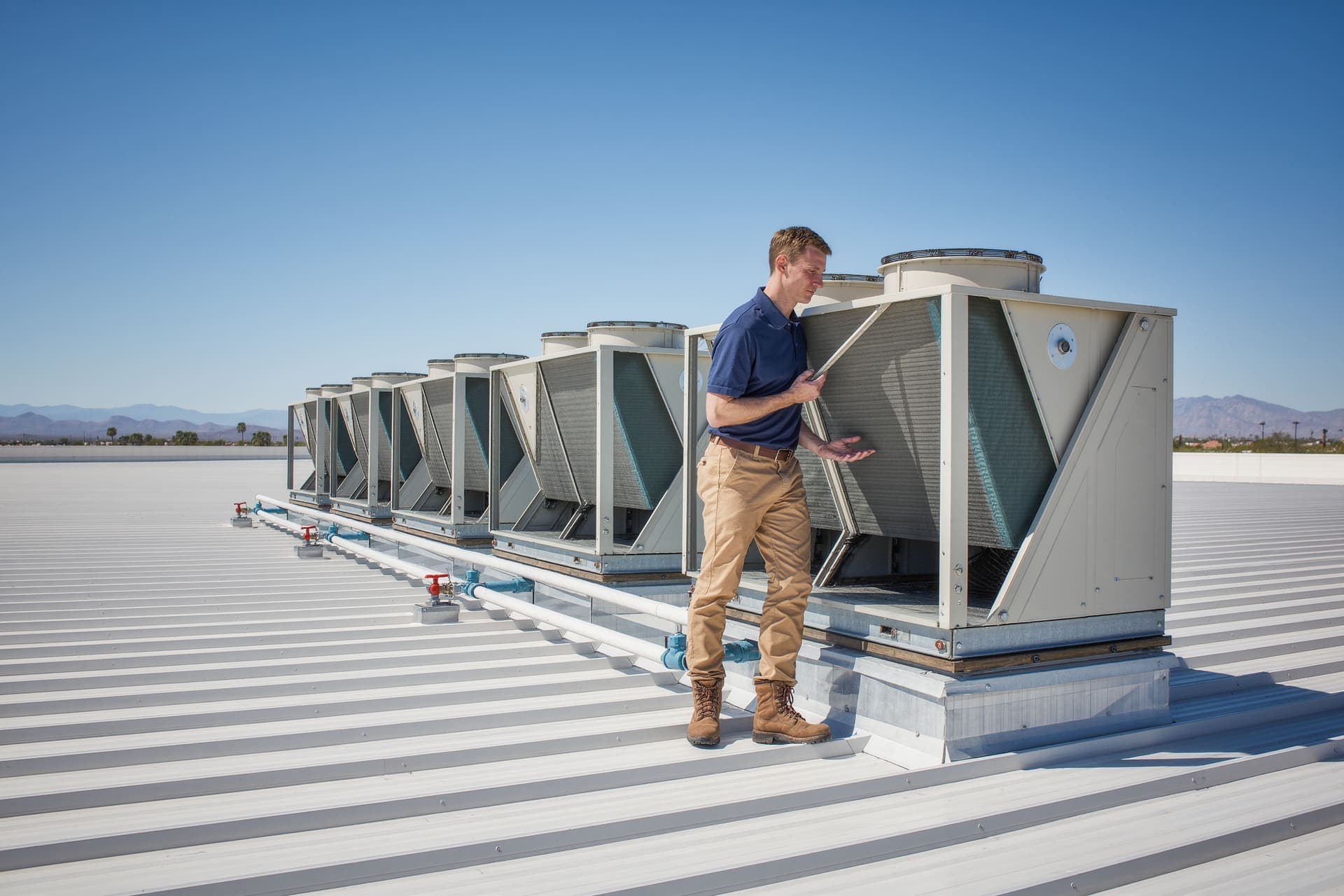
Symptoms We Are Called For
What It Looks Like, and What It Usually Is
| Symptom | Likely causes |
|---|---|
| Cooler runs but air is barely cooler than outside | Dry or scaled media, failed pump, plugged distribution, or high humidity — during monsoon season the physics simply stops working. |
| Musty or sour odor from supply air | Biological growth in the basin or media, stagnant water, or media past its service life. |
| White crust on media and cabinet | Scale from inadequate bleed-off — the water-management system is not discarding enough concentrated water. |
| Water overflowing or basin running dry | Failed float valve, stuck make-up valve, clogged drain, or excessive bleed-off. |
| Reduced airflow | Scaled or collapsed media, loose belt, failed blower motor, or a damper stuck partly closed. |
Direct, Indirect and Hybrid Systems
Direct evaporative coolers — Phoenix Manufacturing's AeroCool, Frigiking and Brisa lines, Champion and Essick MasterCool units, Cambridge Air Solutions E-Series for industrial volumes — are the workhorses: roof- or side-mounted units with rigid or aspen media, a recirculating pump, a blower and a bleed-off system. Indirect evaporative equipment from Munters Oasis, Seeley Climate Wizard and the legacy Coolerado M-cycle families cools air through a heat exchanger without adding moisture to the supply stream, which makes it suitable for pre-cooling outside air into a conventional system or for spaces where humidity matters.
Hybrid arrangements pair evaporative pre-cooling with refrigerated equipment: an indirect evaporative section takes the first thirty degrees off the outside air, and a much smaller DX or chilled-water coil finishes the job. On a DOAS or a large air handler in Phoenix, this arrangement can cut outside-air cooling energy dramatically. Portable and spot-cooling equipment from Portacool and Big Ass Fans serves loading areas and production lines where engineered comfort cooling is impractical.
Water: The Whole Problem
An evaporative cooler is a water-treatment device that also cools air. Phoenix water is hard, and every gallon that evaporates leaves its minerals behind on the media. Without adequate bleed-off — continuously discarding a portion of the recirculated water — the media scales solid, the pump clogs, the distribution troughs plug and the cooler becomes a rooftop humidifier. Rigid media lasts several seasons when water is managed; it can be ruined in one when it is not.
Water also drives the biological questions. Standing water in a warm basin grows things. Basin cleaning, media replacement schedules and, on larger systems, biocide programs are part of responsible evaporative operation, and they are part of our service.
Seasonal Service
Evaporative equipment runs on a calendar. Spring startup: media inspection or replacement, basin cleaning, pump and float verification, belt and bearing service, bleed-off calibration, damper operation and control checks. Mid-season: media condition, scale, water chemistry and airflow. Fall shutdown: drain, dry, cover and protect against the winter — a step skipped by many owners, and a reliable source of spring surprises.
Repairs cover pumps, floats, motors, belts, bearings, media frames, distribution systems, basins, dampers and controls. Most evaporative repairs are inexpensive relative to refrigerated equipment; the cost of neglect is not the repair bill but the summer afternoon the building has no cooling at all.
When to Replace, and With What
Coolers with corroded cabinets, failed basins or media frames that no longer seal are replacement candidates. So are units that are undersized for a space whose use has changed. The more interesting replacement decision is whether to stay evaporative at all: a warehouse that has become a climate-sensitive distribution facility, or a shop that has added office space, may be better served by a hybrid system or by refrigerated cooling in the occupied zones with evaporative cooling in the open floor. We assess the space, the use and the utility spend before recommending a direction.
Manufacturers We Encounter
Brands in the Evaporative Cooling Category
Bleuwave services these manufacturers on an independent basis. Each page covers the families we see in Phoenix and how we approach them.
Straight Answers
Questions We Hear on This One
Is evaporative cooling good enough for our office?
Usually not. Evaporative cooling cannot hold a precise temperature, adds humidity and loses effectiveness during monsoon season. It excels in warehouses, shops and open industrial spaces. For occupied offices and retail we generally recommend refrigerated cooling, sometimes with evaporative pre-cooling of the outside air to reduce cost.
Why does our cooler stop working in August?
Humidity. Evaporative cooling depends on dry air to absorb moisture. When monsoon humidity rises, the air is already carrying water and the cooling effect collapses. This is the technology's inherent limit, not a malfunction — though it is worth verifying the media and pump while the season is on.
How often should evaporative media be replaced?
Rigid media can last several seasons with good water management and a fraction of one without it. We inspect media condition at each service and replace it when scale or degradation has reduced its wetting and airflow performance.
What is indirect evaporative cooling?
Cooling air through a heat exchanger so that it is cooled without picking up moisture. It produces drier supply air than direct evaporative cooling and is useful for pre-cooling outside air into a conventional HVAC system, cutting the energy the refrigerated equipment has to spend.
Free Commercial Estimate
Get a Straight Answer and a Free Estimate
Tell us what the building needs. We'll tell you what it costs — plainly, promptly, and without a sales pitch.
Same-day response. Answered by a person with the authority to act, not a queue with a hold song.
Upfront pricing. The figure quoted is the figure invoiced. The arithmetic never changes after the fact.
Veteran owned & operated. Early, exact, and accountable — the doctrine came before the company.
Prefer the phone? It's answered around the clock: (480) 863-5855