Commercial HVAC Equipment
Commercial Refrigeration Repair & Service in Phoenix, AZ
A walk-in cooler holds product at 38 degrees. Its condenser is on a roof at 160. That is the whole job.
Commercial refrigeration is HVAC's demanding cousin: the same compressors, condensers, evaporators and refrigerants, working against a far larger temperature difference and with far less tolerance for failure. A rooftop unit that struggles on a hot afternoon costs comfort; a walk-in freezer that struggles costs inventory. Bleuwave services commercial refrigeration for restaurants, grocery and food retail, food distribution and institutional kitchens across the Phoenix metro — walk-in coolers and freezers, reach-in equipment, condensing units, evaporators, supermarket rack systems and ice machines.
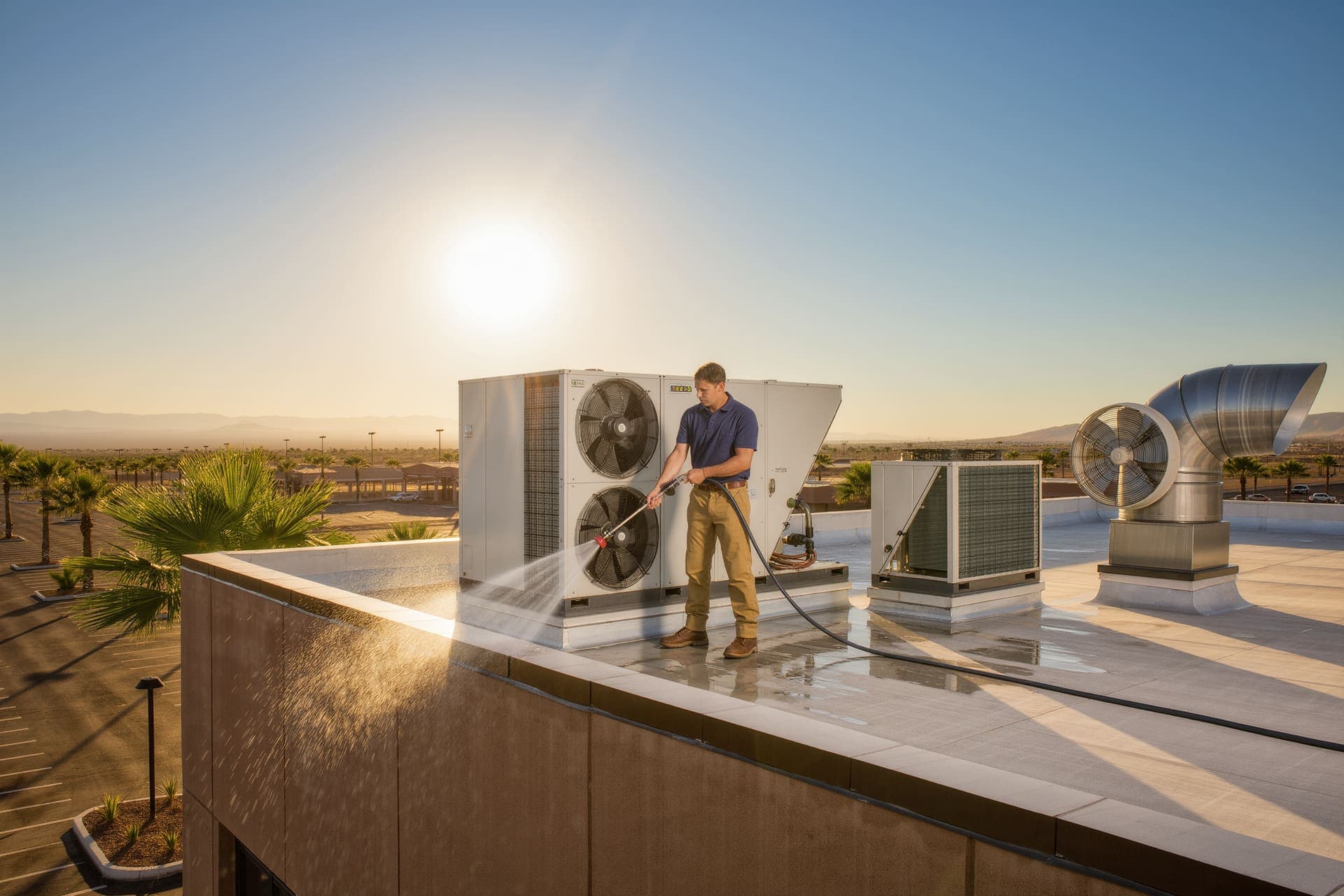
Phoenix puts refrigeration equipment in a position no design engineer would choose. The condensing unit sits on a roof that reaches 160 degrees in July, trying to reject heat from a box held at 38 or minus 10. Head pressures run at the top of the safe range for months. Compressors work harder, run longer and fail sooner than their national service-life averages. Tolleson's food-distribution corridor, the grocery chains across the Valley and every restaurant kitchen in the metro run this equipment through the same summer, and it needs service calibrated to it.
Symptoms We Are Called For
What It Looks Like, and What It Usually Is
| Symptom | Likely causes |
|---|---|
| Walk-in temperature creeping up in the afternoon | Dirty condenser coil, condenser fan failure, low refrigerant charge, or a compressor losing capacity under high head pressure. |
| Ice buildup on the evaporator coil | Defrost failure — timer, heater or termination switch — or a door left open, or a failed evaporator fan. |
| Compressor short cycling or tripping on overload | High head pressure from a fouled or fan-failed condenser, low charge, failed contactor or capacitor, or a compressor nearing failure. |
| Ice machine producing less or thin ice | Scale on the evaporator plate, water-supply or float problems, dirty condenser, or a refrigerant issue. Phoenix water scales ice machines quickly. |
| Rack system alarms across multiple cases | Compressor or condenser problem at the rack, suction-pressure control fault, or a supervisory controls issue — a system problem rather than a case problem. |
Equipment and Manufacturers
Copeland compressors — Discus, Scroll and digital families — and Copeland condensing units are the foundation of much of the installed base. Heatcraft Refrigeration Products (Bohn, Larkin, Climate Control and Chandler brands) supplies condensing units, evaporators and unit coolers for walk-ins; Russell, Witt and Kramer serve similar applications. Supermarket refrigeration runs on parallel rack systems from Hussmann (Protocol, Innovator and micro-distributed systems) and Hillphoenix (Advansor CO2 and conventional racks), with cases, condensers and controls from the same suppliers. Ice machines from Manitowoc, Hoshizaki and Scotsman appear in nearly every food-service operation.
Controls are their own layer: Danfoss pack controllers, drives and valves; Emerson E2 and Site Supervisor supervisory controls and the legacy CPC platforms in older stores. Refrigeration controls monitor case temperatures, stage compressors, manage defrost and log alarms — and when they fail, product loss follows quickly.
Heat, Head Pressure and the Phoenix Compressor
Refrigeration condensers are typically air-cooled and roof-mounted. Rejecting heat from a low-temperature box to 115-degree air demands high condensing pressure, and high condensing pressure means high compressor discharge temperature, higher amperage and accelerated wear on valves, bearings and windings. Dust on condenser coils compounds all of it. Evaporative condensers and water-cooled arrangements help on larger systems; on a restaurant walk-in, the answer is condenser cleanliness, correct charge and a fan that actually runs.
The failure math is unforgiving. A compressor that fails at 2 a.m. in a walk-in freezer gives you until roughly mid-morning before product temperature crosses the line. Emergency refrigeration service is not a premium option here; it is the baseline expectation, and our 24/7 emergency line treats refrigeration calls accordingly.
Diagnosis and Repair
Refrigeration diagnostics follow the refrigeration circuit: compressor amperage and condition, condensing and evaporating pressures against the refrigerant and box temperature, superheat at the evaporator, subcooling at the condenser, defrost operation, evaporator fan and airflow, door gaskets and closers on walk-ins, and the controls that coordinate it. Refrigerant leaks are found and repaired, not simply recharged — a system that needs charge every summer has a leak, and topping it off is a way of paying for the same refrigerant twice.
Repairs cover compressors, condenser and evaporator fan motors, contactors, capacitors, expansion valves, solenoids, defrost timers and heaters, controls, gaskets and refrigerant circuit repair. On rack systems we service compressors, oil systems, condensers, EPR and suction controls, case controllers and the supervisory system.
Replacement and Refrigerant Transition
Refrigeration equipment has been through a decade of refrigerant transitions, and it is not finished. R-22 systems are aging out. R-404A and R-507 systems face regulatory phase-down. CO2 and lower-GWP refrigerants are the direction of new supermarket installations. A replacement decision on a refrigeration system today includes the refrigerant question: what the new equipment will use, whether the existing system's refrigerant will remain available and affordable for its remaining life, and whether a retrofit to an alternative refrigerant is practical. We lay out the options with their costs and their regulatory horizons.
Replacement scope covers condensing units, evaporators, complete walk-in refrigeration systems, and, for larger operations, rack systems and their controls. Sizing is done from the box load, the product, the door traffic and the Phoenix condensing conditions rather than from the old nameplate.
Manufacturers We Encounter
Brands in the Refrigeration Category
Bleuwave services these manufacturers on an independent basis. Each page covers the families we see in Phoenix and how we approach them.
Straight Answers
Questions We Hear on This One
Do you provide emergency refrigeration service?
Yes, around the clock. A refrigeration failure has a shorter clock than a comfort-cooling failure — product is at risk within hours — and our emergency line treats walk-in and rack calls as priority dispatch.
Why does our walk-in condenser need cleaning so often?
It is on a Phoenix roof. Dust loads the coil continuously, and a dirty coil raises head pressure, which raises compressor temperature and shortens its life. Quarterly condenser cleaning is standard practice here, more often in dusty locations.
Our system uses R-404A. Should we be concerned about the phase-down?
You should have a plan. R-404A remains available but faces regulatory phase-down and rising cost. A system with years of life left may be a retrofit candidate; an aging system is likely a replacement candidate with a lower-GWP refrigerant. We assess and lay out the options.
Do you service supermarket rack systems?
Yes — Hussmann, Hillphoenix and similar parallel rack systems, including compressors, condensers, case controllers and Emerson and Danfoss supervisory controls. Rack service requires refrigeration specialists, and ours are experienced with food-retail systems.
Free Commercial Estimate
Get a Straight Answer and a Free Estimate
Tell us what the building needs. We'll tell you what it costs — plainly, promptly, and without a sales pitch.
Same-day response. Answered by a person with the authority to act, not a queue with a hold song.
Upfront pricing. The figure quoted is the figure invoiced. The arithmetic never changes after the fact.
Veteran owned & operated. Early, exact, and accountable — the doctrine came before the company.
Prefer the phone? It's answered around the clock: (480) 863-5855