Industries · Warehouse
Warehouse & Distribution Center HVAC in Phoenix, AZ
You cannot air-condition 500,000 square feet with 36-foot ceilings and forty dock doors. You can make it survivable, and that is a design problem.
The west Valley — Goodyear, Tolleson, Buckeye, Glendale — has become one of the largest logistics markets in the country, and its warehouses and distribution centers are enormous, tall, open and full of people who have to work through a Phoenix summer. Refrigerated cooling of that volume is uneconomic for most operations; the answer is a combination of evaporative cooling, high-volume air movement, spot cooling at workstations, and refrigerated cooling only where the product or the people require it — the office pod, the break room, the climate-sensitive storage. Heating is a few weeks a year with direct-fired or unit heaters. Bleuwave services warehouse and distribution HVAC across the metro.
The design question is what the building is for. A dry-goods warehouse needs its workers safe and its product below a temperature threshold; a pharmaceutical or food distribution center needs precise conditions in part or all of the space; a fulfillment center with hundreds of pickers needs comfort at the workstations. The equipment follows the answer.
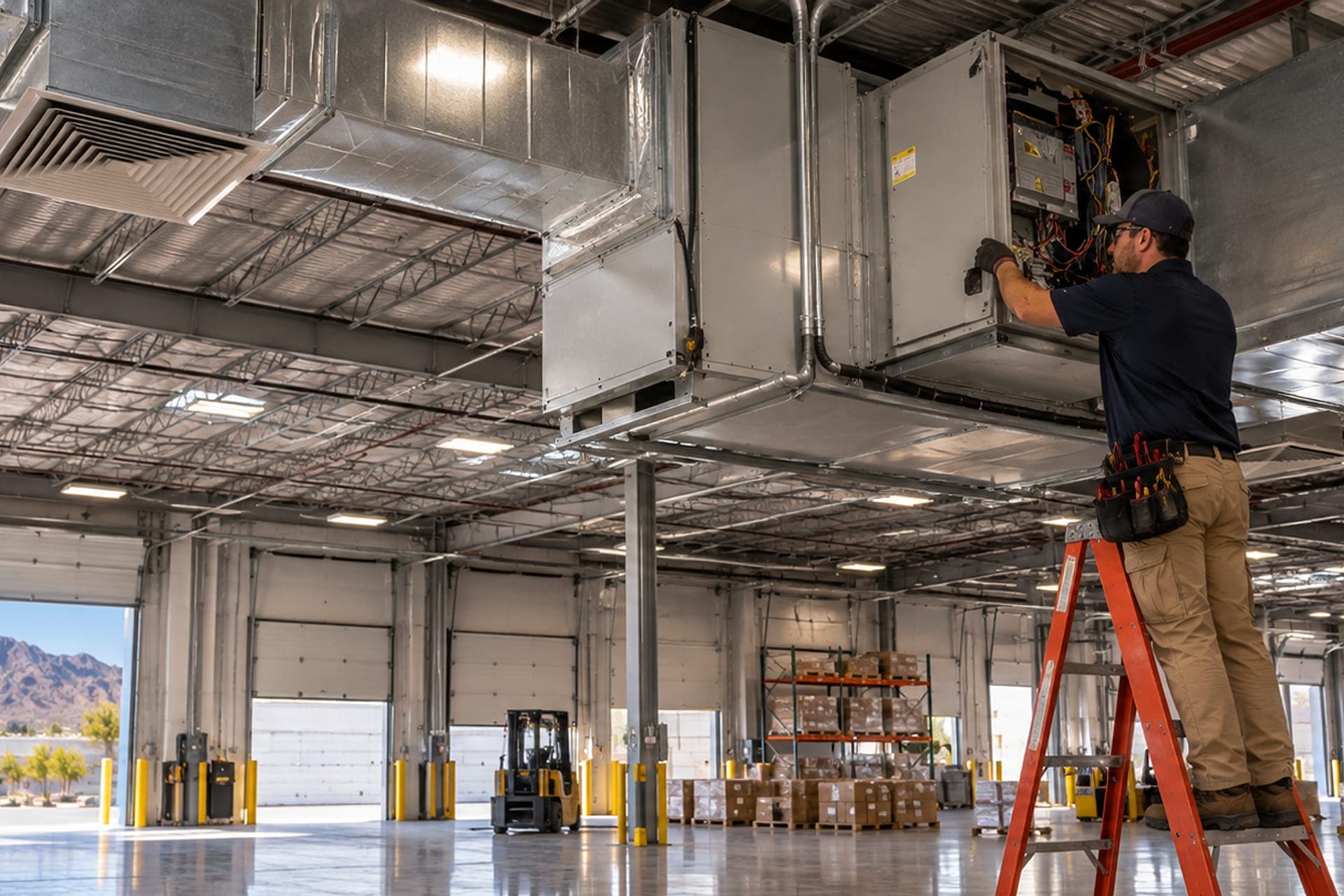
Cooling the Big Box
Direct evaporative cooling — large rooftop or wall units from Phoenix Manufacturing, Cambridge, Champion and others moving huge volumes of cooled outside air — is the workhorse of Phoenix warehouse cooling, at a fraction of the energy of refrigeration and with the limitation that monsoon humidity cuts its effectiveness. HVLS fans distribute the cooled air and add the cooling effect of air movement. Indirect evaporative and hybrid systems produce drier air for spaces that need it. Portable coolers serve dock doors and specific work areas. Refrigerated rooftops or splits serve the office pod and any climate-sensitive zone.
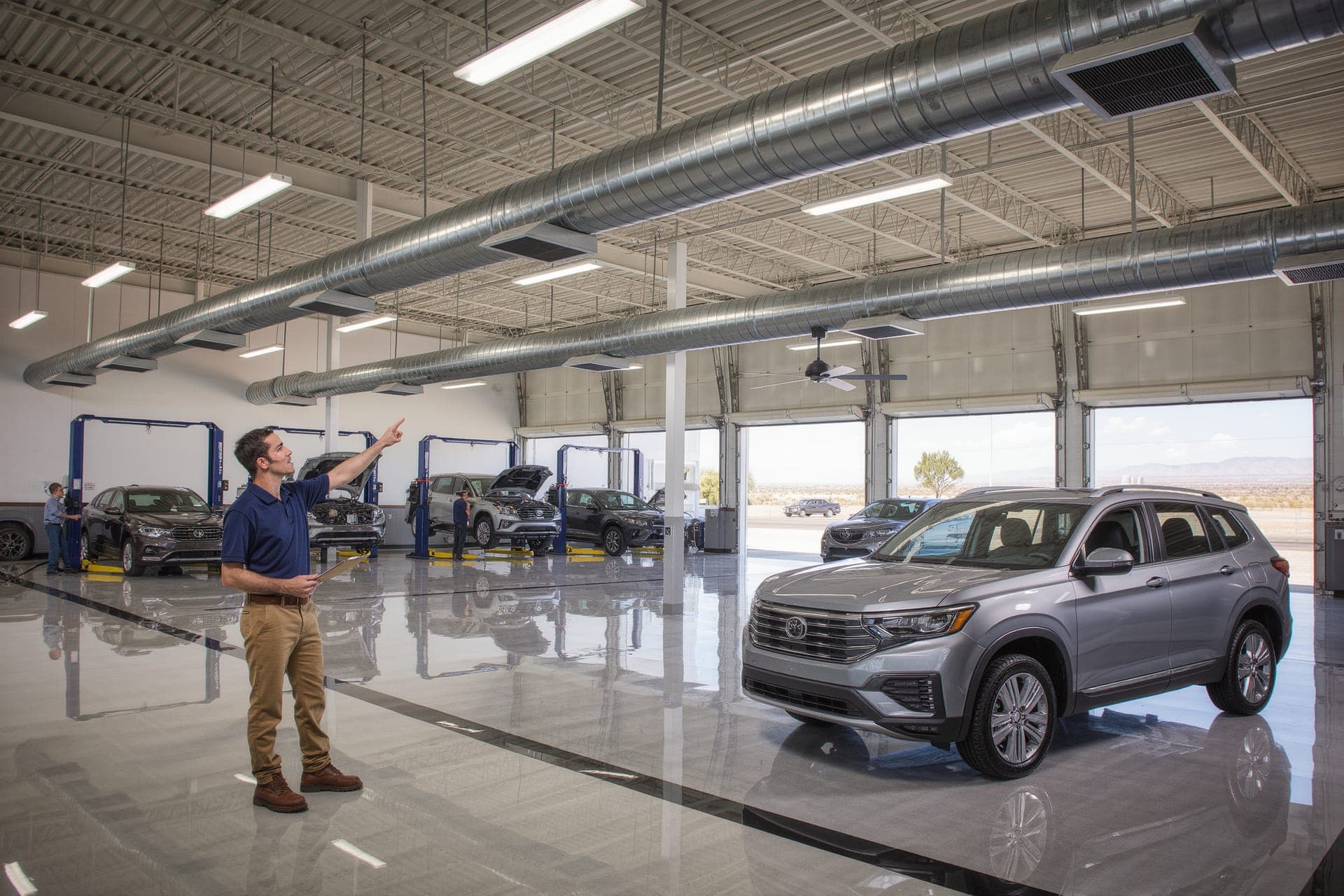
Heating, Ventilation and Pressurization
Direct-fired heaters and gas unit heaters — Cambridge, Reznor, Modine — handle the short heating season; infrared radiant heaters warm the floor and the people in high-bay spaces more efficiently than heating the air. Forklift exhaust, battery-charging areas and process exhaust need make-up air, and building pressurization matters when forty dock doors are open. Destratification fans push heated air back down in winter.
Service and Seasonal Programs
Evaporative equipment runs on a calendar — spring startup, mid-season checks, fall shutdown — and its water management decides whether it works in June. Heaters need pre-season combustion and safety verification. HVLS fans need annual structural and drive inspection. The office pod's rooftop needs the same service as any commercial unit. We provide seasonal programs, repair and replacement for warehouse HVAC, and we advise honestly on where evaporative cooling stops being the right answer.
Equipment in These Buildings
Manufacturers We Often See
Straight Answers
Questions From Warehouses & Distribution Centers
Can a warehouse be air-conditioned in Phoenix?
Parts of it, economically — offices, break rooms, climate-sensitive storage. The open floor is usually evaporative cooling and air movement. We design the combination around what the building is for.
Why does our evaporative cooling stop working in August?
Monsoon humidity. Evaporative cooling depends on dry air, and when humidity rises the effect collapses. It is the technology's limit, not a malfunction — though we verify the media and pumps while the season is on.
Do you service HVLS fans?
Yes — annual inspection of mounts, hardware, drives and controls, plus repair and integration with evaporative systems.
Free Commercial Estimate
Get a Straight Answer and a Free Estimate
Tell us what the building needs. We'll tell you what it costs — plainly, promptly, and without a sales pitch.
Same-day response. Answered by a person with the authority to act, not a queue with a hold song.
Upfront pricing. The figure quoted is the figure invoiced. The arithmetic never changes after the fact.
Veteran owned & operated. Early, exact, and accountable — the doctrine came before the company.
Prefer the phone? It's answered around the clock: (480) 863-5855